Friday, May 20, 2016

Research Project of 4.0A group

Ecology Research Project: Plant Growth Proposal By Ali, John, Tony, Robert, and Kyle


This research aims to elucidate into the relationship between soil contents and plants’ indeterminate growth. Specifically, soil from four different locations will be collected, and tested correspondingly to measure the level of nitrogen (N), phosphorus (P), potassium (K), and pH. These soil contents that are assumed to contribute to plants’ growth.. For this reason, this research requires instruments with the capacity to measure levels of N, P, K, and pH in soil. The four different locations are divided into three categories including soil from city, soil from forest, and soil from beach. Since, there is a density of human populations in cities making it important to be accurate on how the levels of the soil contents affects the plant's’ growth, two soil samples will be randomly collected from cities from two different locations including soil from Edmonds Community College and soil from Shoreline. The soil sample collected from a forest will be collected in a random location of Meadowdale Park. Furthermore, the soil sample collected from beach will be collected from beach. Plant that will be utilized in this experiment will be Zinnia.
            Fertile and healthy soil is the basis for healthy plants. This research is significance in multiple ways. Firstly, the research experiment could help the Environmental Protection Agency (EPA) and the scientists at Edmonds Community College to identify soil contents in the soil so that they could devise solutions to control them.

Figure 1. Zinnia


            On Wednesday 18th May 2016, we took soil from Meadowdale Park, Seattle, EdCC, Edmonds Beach to start our research project. We used Zinnia for our experiment which is considering as fast growing plant. We made 5 categories and 3 samples for each soil which includes above four and potting soil (so total 15 pots). Before planting the plants in the pot, we did N,P,K, and pH measuring test for each soil with testing kit.


Figure 2. Phosphorous testing


Figure 3. pH testing

Figure 4. Nitrogen testing


            And then we measured total mass, length of the shoot & root, number of the leaves, color of the stem & leaves, and length of the first internode. After collecting all the data, we planted the plant to pots with each designed soil. And then we watered them each with one cup of water.
         
Figure 5. Measuring

Figure 6. Planted Zinnia to various soil


             For additional experiment, we made five more pot which are to examine germination of the seeds in different condition of soil. Normal time to germinate is 10-15 days which is longer than our experiment day but we decided to do it to see what will happen. We watered them each with half cup of water. Every planted pot were placed under the light in the lab and we will going to water them on 23rd Monday and finish the experiment on 25th Wednesday.
Figure 7. Seed germination experiment


Reference: https://orchidflowers.wordpress.com/2011/04/11/growing-zinnia-flowers-from-seeds/

Wednesday, May 18, 2016

Herbivore Project by [Fun-Guys]

Members: Brian, Eunice, Jaena, Thomas, Reylene

The purpose of our project is to test the preference and the performance of the Manduca sexta (Tobacco Hornworm). We are comparing two plants (TBD) and testing which plant does the caterpillar prefer. Also we are testing whether the plant they prefer to eat is the plant they benefit from the most.
The method of our experiment for the preference is that we cut the two species of leaves to equal shape and size, and place them inside a petri dish with a caterpillar. The dish would be checked after some scheduled time and noted which species of leaf was most eaten. For the performance, the caterpillar would be weighed before placed in the petri dish with only one kind of leaf. After sometime, the caterpillar would be weighed again, and the gained weight among the caterpillars would be compared by the type of leaf they were assigned to.
For the mock experiment, on Monday, May 16, Petunia and Nicotiana was used for the two species of plant. The leaves were cut in circles and 10 dishes were made to test whether the apparatus works. For the second experiment, six dishes, three for each plant, were set up additionally to test performance. The weight of the caterpillar at this time ranged from 0.9g to 1.2g. Both experiments were left to run for 24 hours.  Afterwards, data was collected and the dishes were reset to run another 24 hour period experiment.

photo_2016-05-16_22-18-49.jpg
photo_2016-05-16_22-18-51.jpgphoto_2016-05-16_22-18-53.jpg
photo_2016-05-16_22-18-48.jpg

The following day, after about 24 hours past, the results of the mock experiment were checked. It turned out that the circles were not big enough to suit some caterpillar's appetite and it seemed like some leaf and the caterpillar was dried out by being placed under the light. So we set up a smaller trial of five new petri dishes to see if they would do better in the dark. The caterpillars from the Monday’s experiment and one new performance dish was put under the light on moist paper towel to see if it would do better with some moisture.

photo_2016-05-18_02-35-32.jpg

photo_2016-05-18_02-35-36.jpgphoto_2016-05-18_02-35-34.jpgphoto_2016-05-18_02-35-38.jpg


Data from May 17, 2016:


F = Full leaf, H = Half Leaf, 0 = No leaf was eaten

Sample Number
Petunia (F/H)
Nicotiana (F/H)
000
1H
0
001
1H
0
002
0
0
003
0
0
004
1F
1F
005
1F
1H
006
2F
1H
007
1F/1H
1H
008
1F/1H
0
009
0
1F


Friday, May 6, 2016

Ecosphere blog post by:Taylor Jones, Amy Latimer, Lisa Merritt, and Shawna Steele

Contents of ecosphere:
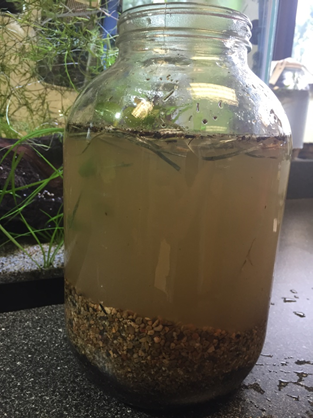
Originally we had put 117.9 grams of soil into our jar but once 500mL of water was added, the water was too dark for any life to live in. So because of this, we poured out the water and started over.
4 cups of sand
3 cups of gravel
Added some hay
150 mL of algae food source
¾ of water was tap water and the last ¼ was pond water
2mL selenastrum capricornutum is a genus of green algae. It is a Producer/photoautotrophic, photochemolithotrophic organism.
1 water sprite
1 bacopa is a genus of 70–100 aquatic plants in the family of Plantaginaceae. It is a Producer/photochemolithotrophic, photoautotrophic. Produce food through photosynthesis and cell respiration. are found in tropical and subtropical regions of the world, particularly in the Americas. It has been used in India for medicines to improve mental clarity.
4mL anabaena is a genus of filamentous cyanobacteria. Anabaena exists as plankton, are well known for their nitrogen fixing abilities and symbiotic relationships with plants. In this symbiotic relationship they produce neurotoxins in order to protect plants from grazing pressure. Anabaena is a Producer and is photoautotrophic 1 shrimp (Jerry)--Consumer/chemoorganoheterotroph


Ecosphere Observation Day 1 – water is a little too murky that desired, probably due to the amount of soil we put at the bottom of the jar
Ecosphere Observation Day 2 – Our little buddy Jerry died. Also, notice the number of anabaena (the white dots) is in the picture
Ecosphere observation Day 3 – Jerry’s body has disappeared, probably was decomposed by the water or other organisms. The amount of anabaena has increased (there are more white dots in the picture in comparison to day 2).

As you can see in the images that there has been substantial plant growth in our ecosphere. As a group we expect the amount of daphnia to increase and grow in size. More Anabaena will also produce and maybe lead to the growth of more plants and organisms.

Ecosphere Blog Post By The Dream Team

By: Matthew Heinekin, Ivanna de Anda, Nhy Tran

Ecosphere Ingredients:

  • Pond water
  • 200 ml of Nutrients
  • Tap water
  • Bacopa (2x)
  • Water Sprite
  • Daphnia (20x)
  • Volvox globator
  • Stentor
  • Euglena acus
  • Anabeana
  • Aquatic floating fern
  • Snail
  • Soil
  • Sand
  • Gravel
  • Straw
Figure 1.  The Dream Teams amazing Ecosphere with Daphnia and the Snail.
Our initial predictions upon finishing the construction of our Ecosphere was that it would persist, grow, and even flourish. As it turns out our predictions were correct, The quantity of daphnia has increased exponentially as well as the size of them. Not only did the daphnia get bigger, but the aquatic floating fern grew, as well as the othertwo plants that was introduced into the ecosphere. We feel that by adding a good amount of soil first and then straw, that was the key to grow an amazing ecosphere. we also used both sand and gravel in order to keep the dirt and ay from just floating around in the water and making it dirty. At one point during the past week or so, we noticed a thin clear white layer on the floor of the Ecosphere. As we discussed it over with each other, we concluded that it must have been some sort of fungi growing.
Figure 2. Close up on the ecosystem and the Snail.
Types of metabolism for each organism:

Aquatic Floating Fern - photosynthesis and cellular respiration
Water Sprite - photosynthesis and cellular respiration
Bacopa - photosynthesis and cellular respiration
Anabaena- autotrophic
Selenastrum Capricornutum - autotrophic
Volvox Globator - autotrophic
Stentor- autotrophic
Snail- heterotrophic
Euglena acus- photosynthetic

Expectations:
As the weeks progress, we feel that our Ecosphere will continue to thrive without any issues. Based on what the ecosphere was composed of, we believe that there will be enough nutrients and food sources for all the organisms that live within it.


Ecosphere post by [Fun-Guys]

Biosphere Ingredients:

Ground material/water used:
Soil (19.27g)
Sand (111.63g X 3)
Gravel (90.61g)
Algae nutrient water (200 mL)
Pond water (>2000mL)

Aquatic Floating Fern (1 Plant)
Water Sprite (1 Plant)
Bacopa (1 Plant)
Anabaena (~20 mL, Algae- autotrophic)
Selenastrum Capricornutum (~20 mL, Algae- autotrophic)
Volvox Globator (~20 mL, Algae- autotrophic)
Snail(1, Gastropod-heterotrophic)


Organisms spotted that were not  purposely added, thus existed in pond water:

Gnats
Small floating white things in water (Possibly Ostracods?)


Predictions for our biosphere:

  1. Algae would grow with no inhibitors and quickly due to the algae nutrient water, as well as natural nutrients found in the pond water.
  2. We would gain unknown organisms through the pond water sample that would create a unique enviroment.
  3. The oxygen level would increase as three plants and three algae were present in the biosphere using photosynthesis
  4. Our snail would have plenty of food from the plants and algae.


Types of metabolism for each organism:

Aquatic Floating Fern - photosynthesis and cellular respiration
Water Sprite - photosynthesis and cellular respiration
Bacopa - photosynthesis and cellular respiration
Anabaena- autotrophic
Selenastrum Capricornutum - autotrophic
Volvox Globator - autotrophic
Snail- heterotrophic


Group observations:

So far so good!
All the organisms that were added in our biosphere are all still living and growing! There has been the appearance of a few organisms in our biosphere which we were not aware of at time of creation. One of these organisms we believe are Ostracods, which are small crustaceans and most commonly found in fresh water/ forest humid soil. We believe it might be this organism due to their rapid population growth. Ostracods can reproduce asexually by cloning themselves. These organisms might have flourished due to the nutrients available that are biproducts of the producers, or the plants that aren’t being consumed by other organisms in our biosphere. Overall, our ecosphere looks amazing. Our predictions for the following week are that we expect the snail to possibly reproduce since they reproduce asexually. There are no predators in the environment, and plenty of food to consume, therefore the snail should be able to survive, grow, and possibly reproduce.


Biosphere Pictures:

photo_2016-05-04_17-09-48.jpgphoto_2016-05-04_17-09-50.jpgphoto_2016-05-04_17-09-51.jpgphoto_2016-05-04_17-09-53.jpgphoto_2016-05-04_17-09-54.jpg


Ecosphere_Post 1 by Group [4.0 A]


Group Members: John, Tony, Kyle, Ali


Ecosphere Post 1

On April 11th, our group set up a controlled ecosphere in the lab. In order to set up the ecosphere, we were given from a range of different animal and plant species. Or more specifically, we could choose from a mix of autotrophs and heterotrophs. Our goal was to choose species and make an ecosphere that will sustain and grow over the course of several weeks.


Setup of Ecosphere:


The ecosphere was setup in a jar that included:


Soil (51 g)
Sand (238 g)
Gravel (147 g)
Bacopa (1 plant)
Green algae (Selenastrum capriconutum) (2 mL)
Anabaena (Cyanobacteria) (2 mL)
Daphnia (20 counts)
Shrimp (1 count)
Pond water


Food Web of Producers and Consumers:


After setting up the ecosphere, we closed the top of the jar and placed it in a place that can have open source of light. Light is important for organisms that photosynthesize.

Producers:
Plants
Bacopa (photochemolithotrophic, photoautotrophic)
Green algae (photoautotrophic, photochemolithotrophic)
Anabaena (photoautotrophic)


Consumers:
Daphnia (chemoorganoheterotrophic)
Shrimp (chemoorganoheterotrophic)


April 27th:


The above picture was taken about two weeks after the ecosphere setup. While observed, changes were already been seen. There is algae growth on plant branches that was not there when we setup the ecosphere initially.


In the above image, shrimp has molted its skin. At the initial observation on that day, we thought our shrimp was dead. However, after close observations, it was concluded that it is just skin. Lo and behold, we spotted our shrimp that was hiding inside the plants. He was alive and roaming free.

May 2nd: 


The above picture were observed on May 2nd. There was extensive growth of green algae on plant leaves and stems. In addition, the last image shows a big green patch of green algae leaving on the glass. The shrimp and Daphnia were still alive in the ecosphere.

May 4th:


Above two pictures were taken on May 4th. First image shows high concentration of algae on tree side of the jar is directly exposed to sun. It was hypothesize that side of the jar, green algae photosynthesize better and thus have extensive growth. There were also new gametophytes observed in the jar. The Shrimp and Daphnia were still alive. Both organisms have normal growth.

Prdictions: 

We are predicting more algae growth in our ecosphere for next weeks. Shrimp will stay alive and as well as Daphnia. We are predicting normal growth for these two organisms.

ECOSPHERE BLOG POST by REJ

ECOSPHERE BLOG POST
By Group REJ


Group Members: Jaena Ristel Bautista, Robert Barker, Nhung Nguyen
13161458_1158583800827095_1009214099_o.jpg
Figure 1: The photograph of our ecosphere taken on Monday, May 2nd, 2016 at 3:50 pm 

Our group had to attempt making our ecosphere twice due to too much soil. We had a hard time planting the plants because the soil made the ecosystem too dark to see. But luckily, throughout the weeks, the soil deposited for a clearer view of the whole ecosphere.

ECOSPHERE LIST
  • Pond Water (2.92 L)
  • Gravel (446.85 g)
  • Soil (65.57 g)
  • Sand (283.86 g)
AUTOTROPHS
  • Anabaena (3 mL)
  • Volvox (2 squirts)
  • Plants - Ceratopteris and Bacopa Caroliniana
HETEROTROPHS
  • Snail (1)
  • Daphnia (17)


CHANGES AND OBSERVATIONS

13161396_1158583840827091_604922917_o.jpg13161396_1158583840827091_604922917_o.jpg
Figure 2 and 3: The Bacopa Caroliniana plant of our ecosphere.

- The Bacopa Caroliniana was still in good health as shown on Figures 2 and 3.
- Our daphnia were so tiny to be clearly shown on the pictures, but they reproduced a lot! From a number of 17 daphnias, it grew to almost filling all the jar. - There are numerous unidentified organisms in the ecosystem that captured our attention, one of which was a tiny reddish worm-like organism swimming in circular pattern. The organism swam pretty fast but we were lucky enough to photograph it. Below was the best photo we got of this organism, even though it was still a bit blurry.
10917284_1617494041798000_1145337922099502276_n.jpg
Figure 4: The unknown worm-like organism that confused us a while (red circle).

After doing some research, we think this organism could be an aquatic worms. It must have had been in the pond water before we made the ecosphere and until today it still lives very well by eating mud. 

Figure 5: An aquatic worm. We found it look close enough to our unknown organism.


13199466_1158583834160425_872311678_o.jpg

Figure 6: The snail in our ecosphere.


- Above is a picture of our snail that eventually got larger in size. We assumed that this is because of the nutrients coming from the pond water. The snail has easily adapted to the ecosystem we made.


13147993_1158583857493756_1395655531_o.jpg13128834_1158583844160424_1913168154_o.jpg

Figures 7 and 8: The unhealthy Ceratopteris.

- As you can see from Figures 7 and 8, the stems of our Ceratopteris mostly turned brown and looked very weak. If only we could know what caused this plant to be sick :(


EXPECTATIONS
In the following weeks, we expect to see more tiny living organisms. Also daphnia will reproduce more and get bigger in size. The snail will gain more nutrients and be healthier. As for the plants, the Bacopa Caroliniana will keep growing normally while the Ceratopteris might get worse and eventually die.


Source:
http://www.fcps.edu/islandcreekes/ecology/aquatic_worm.htm